.png)
.png)
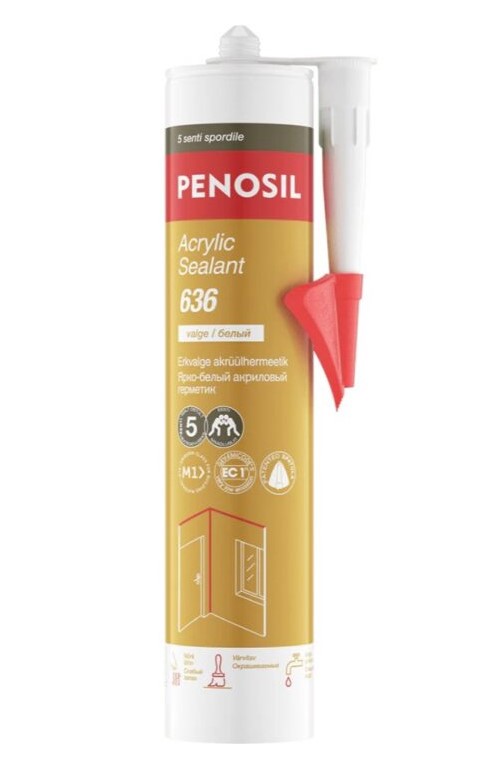
Acrylic sealant, white, 280 ml
PENOSIL Acrylic Sealant 636 is a water-based acrylic sealant with an extra-fine texture, designed for filling gaps and joints prior to painting. It forms a durable, flexible, UV- and mold-resistant bond with common construction materials—such as concrete, plasterboard, and wood—ensuring smooth, flawlessly finished surfaces. With every purchase of Acrylic Sealant 636, you support the Estonian Wrestling Federation and help boost the wrestling careers of children and young people.
Properties
Non-drip; does not slump in the joint
Low odor
Forms a flexible bond
Adheres well to most construction materials
UV- and mold-resistant
Paintable
Application details
Areas of use:
Filling wall cracks and joints.
Filling joints between window or door frames and walls.
Filling joints between plasterboards and screw holes.
Repairing surface irregularities before painting.
Adhesion: Concrete, plaster, plasterboard, brick, wood, construction boards, PVC.
Instructions for use:
Cut off the threaded end of the cartridge and screw on the application nozzle. Cut the nozzle tip to create an opening of the appropriate size for applying the product. Insert the cartridge with the nozzle into the gun and fill the nozzle with acrylic by repeatedly squeezing the trigger. Apply the acrylic to the joint by squeezing the trigger steadily and evenly while sliding the nozzle smoothly along the joint. After application, smooth the acrylic with a rubber silicone spreader. Remove any excess acrylic.
Maximum joint dimensions: 30 × 20 mm; for larger joints, fill in two layers, allowing the first layer to dry completely (curing rate: 2.5–3 mm per day). Painting can be done after final drying, the duration of which depends on the joint dimensions (curing rate: 2.5–3 mm per day). Painting too early may cause cracks to form in the paint as the acrylic dries.
Tips:
Application temperature range: +5°C to +40°C.
Surfaces must be free of grease, oil, dust, and debris.
The surface to be sealed must be dry.
Maximum recommended joint dimensions: 30 × 20 mm.
The product cures through drying (water evaporation). High humidity, low temperatures, and significant joint depth can significantly slow down skin formation and curing.
It is highly recommended to coat the cured sealant with a suitable paint to ensure longevity and a color match with the surrounding surface. Can be painted after final curing. Curing time depends on joint dimensions (2.5–3 mm/day). Premature painting may cause the paint to crack. Ensure adequate ventilation at all joints.
Ensure that no dirt settles on the surface and the joint is not subjected to mechanical stress during the curing period.
Do not use at temperatures below +5°C.
Limitations:
Not suitable for joints with high movement (exceeding 8% of the joint width).
Not suitable for joints in constant contact with water.
Not suitable for joints involving bituminous surfaces.
Poor adhesion to glass and certain plastics.
May cause corrosion on bare metal surfaces.
Cannot be sanded like putty after curing.